947 words · 4 min
Tupac: Resurrection (2003)
Oscar-nominated 2003 documentary by Lauren Lazin in which Tupac tells his own story, built entirely from his interviews. Co-produced by Afeni Shakur's Amaru.
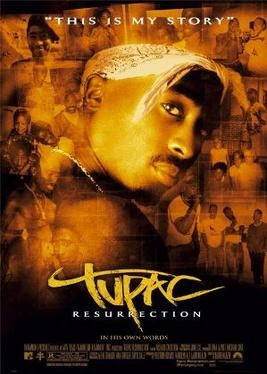
- Director
- Lauren Lazin
- Producers
- Lauren Lazin, Preston Holmes, Karolyn Ali; MTV Films and Amaru Entertainment
- Executive producers
- Afeni Shakur, Van Toffler, David Gale
- Cinematography
- Jon Else
- Editing
- Richard Calderon
- Distributor
- Paramount Pictures
- Premiere
- January 22, 2003, Sundance Film Festival
- U.S. release
- November 14, 2003, in about 800 theaters
- Running time
- about 111 minutes
- U.S. box office
- $7.7 million, including $4.6 million on opening weekend (Box Office Mojo)
- DVD
- Paramount Home Video (U.S. release on June 15, 2004)
Tupac: Resurrection is the best-known documentary about Tupac Shakur and the only one to have earned an Oscar nomination. Its trick: there is no off-screen narrator and no experts talking about Tupac. Tupac tells the story himself, assembled from interviews he gave between his youth and 1996.
Because the film is a documentary, it is listed here among the documentaries.
Key Facts on the Film
Amaru Entertainment is the company of Tupac’s mother Afeni Shakur, who managed the estate. The film is therefore an authorized production, with access to home videos, concert footage, poems and diary pages that no one had seen before. Producer Preston Holmes had known Tupac since he was a child; he had already co-produced Juice and suggested him for Gridlock’d.
An Autobiography Made from Archive Footage
Director Lauren Lazin worked frequently for MTV. From hundreds of hours of audio and film footage, including conversations with MTV reporter Tabitha Soren, she assembled a film in which Tupac speaks himself from beginning to end. Kenneth Turan wrote in the Los Angeles Times that it was more a film autobiography than a traditional documentary. Besides interviews and concert footage, Lazin also worked with on-screen text, drawings, greeting cards and pages from Tupac’s notebooks.
The opening already sets the tone. Over images of Las Vegas, shot by cinematographer Jon Else, Tupac’s voice says: “I got shot.” Only gradually does it become clear that he is talking about the 1994 shooting in New York and not about September 1996. His thoughts on death and the hereafter feel all the more arresting as a result.
What It’s About
The film follows Tupac’s life chronologically: childhood with a mother who stood trial as a Black Panther and later struggled with drugs, the years in Baltimore and Marin City, the path via Digital Underground to solo star and actor. Then the ruptures: trials, prison, the 1994 shooting, the time at Death Row under Suge Knight, and his death in Las Vegas in 1996.
Because the voice is Tupac’s own throughout, the film feels like an autobiography. He talks about poems, about his friendship with Jada Pinkett, about Shakespeare, whom he found “dope,” about the media and about his own mistakes. He remembers how, after a performance at a fundraiser for Jesse Jackson, he discovered the stage for himself: it was better than money, better than sex. About the beating by police in Oakland he says: “I didn’t have a record until I made a record.” Roger Ebert highlighted exactly this way of telling: Tupac’s narration does not sound like the usual celebrity interviews but like written prose.
Release and Box Office
After the Sundance premiere in January 2003, Paramount released the film on November 14, 2003, in about 800 U.S. theaters, an unusually wide release for a documentary. The first weekend brought in $4.6 million, and the total in North America was $7.7 million, a major success for a documentary.
Reception
Kenneth Turan called the film “absorbing and comprehensive” in the Los Angeles Times. One does miss other voices to provide perspective, he wrote, but for a single-point-of-view film, co-produced by Tupac’s mother at that, it is even-handed: Tupac’s difficulties are dealt with unblinkingly. The film is especially good at showing how contradictory Tupac was, a man who admired strong women while writing derogatory lyrics, who decried violence in the Black community while taking part in it himself. One moment he is as well-mannered as Sidney Poitier in conversation with MTV reporter Tabitha Soren, the next he is angrily spitting in every direction. And yet everything feels sincere.
At the 2005 Oscars, the film was nominated for Best Documentary Feature, for Lauren Lazin and Karolyn Ali; the award went to Born into Brothels. Super Size Me, among others, was also nominated. On Rotten Tomatoes, Resurrection stands at 78 percent positive reviews, on Metacritic at 66 out of 100.
The most common objection: Resurrection is a tribute, not an investigation. Because the estate co-produced it and Tupac explains himself, difficult subjects such as the sexual abuse trial or his role in the feud with the East Coast largely remain his own version. The critics’ consensus on Rotten Tomatoes calls the film one-sided but engaging thanks to Tupac’s charisma.
Soundtrack and Book
A soundtrack to the film came out on November 11, 2003, on Amaru and Interscope, executive-produced by Afeni Shakur and Eminem. It mixes well-known tracks with newly assembled songs such as Runnin’ (Dying to Live) with The Notorious B.I.G. and One Day at a Time with Eminem and the Outlawz. The album entered the Billboard 200 at No. 2. More: Tupac: Resurrection, soundtrack. At the same time, the photo book Tupac: Resurrection 1971-1996 was published.
Assessment
If you only want to see one film about Tupac, see this one. It is seriously made, carefully edited and offers a great deal of original material. In it, Tupac himself summed up his life as a story about ambition, violence, redemption and love. You just have to know that the film shows Tupac’s self-image; for critical counter-voices and the investigations into his death, you need other films, such as Dear Mama or the films on the murder case.
People in this text
Afeni Shakur: Panther, Mother, Keeper of the EstateSuge KnightJada Pinkett