621 words · 3 min
Juice (1992)
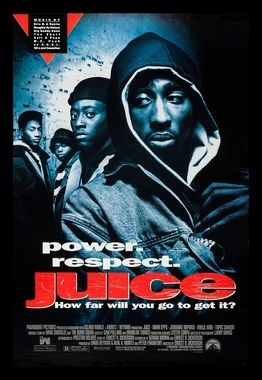
Tupac's breakout screen role: as Roland Bishop in Ernest R. Dickerson's 1992 Harlem drama he plays a friend who turns killer.
- Director
- Ernest R. Dickerson (his feature debut; previously cinematographer on all of Spike Lee’s features)
- Screenplay
- Gerard Brown and Ernest R. Dickerson
- Producers
- David Heyman, Neal H. Moritz, Peter Frankfurt (Moritz/Heyman, Island World)
- Distributor
- Paramount Pictures
- Cast
- Omar Epps (Q), Tupac Shakur (Bishop), Khalil Kain (Raheem), Jermaine Hopkins (Steel), Cindy Herron (Yolanda), Vincent Laresca (Radames), Samuel L. Jackson (Trip), Queen Latifah (Ruffhouse MC)
- Music
- Hank Shocklee and The Bomb Squad
- US release
- January 17, 1992
- Running time
- approx. 95 minutes
- US box office
- $20.1 million, including $8.1 million on opening weekend (Box Office Mojo)
Juice is the film that made Tupac Shakur a name as an actor. He plays Roland Bishop, one of four Harlem teenagers, who loses control after a stick-up and ends up hunting his own friends. In Germany the film was released as Juice, City-War.
Credits
The story
Q, Bishop, Raheem and Steel cut school, hang out in arcades and record stores, and get hassled by the police and a rival crew. Q wants to win a DJ battle. Bishop wants more: respect and power, what the boys call “juice.” He pushes the others into robbing a corner store, where he shoots the owner. He then kills Raheem, tries to pin the murder on someone else and finally turns on Q and Steel.
How Tupac got the part
In 1991 Tupac was still a dancer and rapper with Digital Underground. He walked into the audition almost by accident, tagging along with bandmate Money-B. Speaking to Davey D in 1991, Tupac said he went in “cold turkey” and read. Money-B told Rolling Stone in 2017 that he himself bombed, and that when Tupac read, people outside the room heard applause. In a 1992 Right On! interview Tupac recalled that the casting team first mistook him for Treach of Naughty by Nature, who in the end got a small part in the film himself.
Tupac described Bishop in 1991 as “psychotic, insecure, very violent.” Juice, he said, was not a hip-hop movie but a coming-of-age story that happened to have hip-hop in it.
The poster controversy
The marketing caused trouble before the film even opened. After violence marred the openings of New Jack City and Boyz n the Hood, anti-gang groups in Los Angeles worried that the action-heavy trailers would draw trouble again. The Los Angeles Times reported that Paramount had removed a pistol held by one of the four leads from an early version of the poster. Tupac was not amused: in Right On! he pointed to the ads for Kuffs, in which Christian Slater was allowed to hold a gun.
Reviews
Critics singled out the young cast. Variety called Tupac “also impressive,” and Roger Ebert, giving three stars out of four, credited much of the film’s strength to its actors. Kenneth Turan of the Los Angeles Times found Juice vivid and promising but predictable once the crime plot takes over, and noted that Bishop seems to have taken James Cagney’s psychotic gangster in White Heat as his role model. Germany’s film-dienst later summed it up as convincingly acted but somewhat muddled on the page.
Soundtrack
The soundtrack came out on MCA at the end of 1991, featuring Eric B. & Rakim’s title track Juice (Know the Ledge), Naughty by Nature and Cypress Hill. Tupac himself is not on the album. For his soundtrack contributions, see the discography.
What it meant for Tupac
Juice opened about two months after his debut album 2Pacalypse Now and introduced him to an audience far beyond rap fans. The volatile Bishop shaped his public image for years; directors and journalists kept coming back to the role. His next part, in Poetic Justice, was deliberately different.
People in this text