Friends
Suge Knight
Living · As of October 23, 2026Latest report: September 8, 2026
Football player, bouncer, label boss: Suge Knight got Tupac out of prison to Death Row in 1995 and was driving in Las Vegas. Serving 28 years since 2018.
196519851987199119921995199619972001200520062014201520182022202320252026
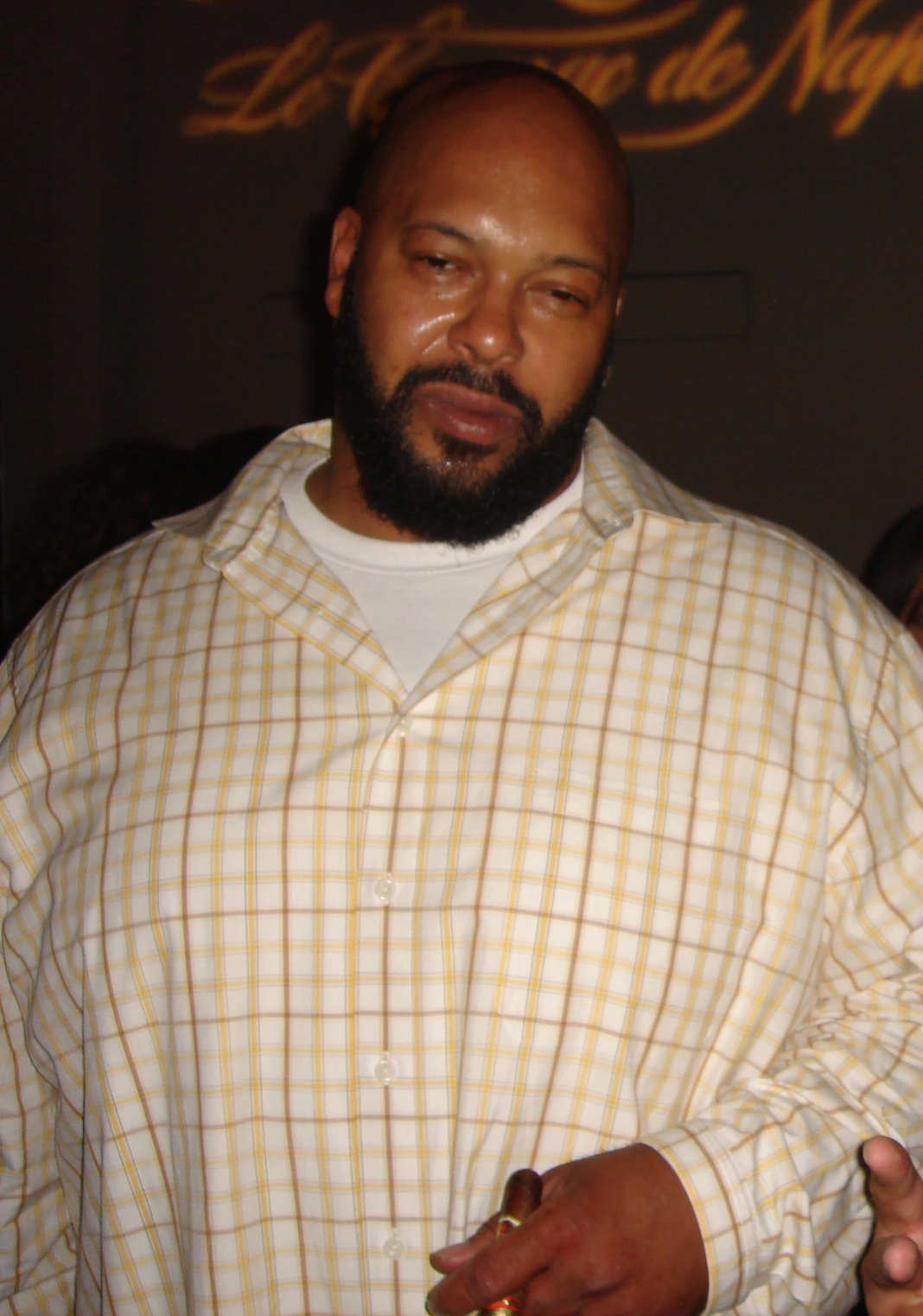
On 12 October 1995, Tupac Shakur walked out of prison in upstate New York because a record label from Los Angeles had posted $1.4 million in bail. Eleven months later, at around 11:15 p.m. on 7 September 1996, the same man who had got him out was behind the wheel of the black BMW that came under fire at a traffic light in Las Vegas. Marion Hugh Knight Jr., known as Suge, was Tupac’s label boss, manager, financier and closest ally in the last year of his life. He is the only survivor from that car, and since 2018 he has been serving a long prison sentence himself.
“Sugar Bear” from Compton
Knight was born on 19 April 1965 and grew up in Compton, in the south of Los Angeles. His nickname goes back to his childhood: in the neighborhood he was called “Sugar Bear”, and his former college coach Harvey Hyde still calls him that today. At Lynwood High School, about twenty minutes from Compton, he won honors in football and track for four years, above all as a defensive lineman.
By way of El Camino College, a junior college in the south of Los Angeles, he made it to Las Vegas: Hyde, head coach at the University of Nevada, Las Vegas (UNLV) since 1981, recruited him. There Knight played nose tackle and defensive tackle in 1985 and 1986, was elected defensive captain and named to the first team of his conference. On the side he worked as a bouncer at the Cotton Club in Las Vegas. According to former teammates, he did not graduate. Hyde later described him as a polite player who “never, in any way” gave him trouble.
His NFL career was brief. When the pros went on strike for 24 days in 1987, the Los Angeles Rams brought in replacement players, and Knight played in two games, against the Pittsburgh Steelers and the Atlanta Falcons. Replacement players were reviled as scabs at the time; Knight, too, was pelted with eggs. His coach with the Rams, John Robinson, does not remember him.
From Security to Music
After football, Knight looked for his money in the music business, first in security and events, then as a manager. The best-known story about him dates from this period: he is said to have held Vanilla Ice by his feet over the railing of a hotel balcony to make him sign over a share of Ice Ice Baby. Knight’s client Mario Johnson, known as Chocolate, claimed rights to songs on the album. In 1999, on the program Behind the Music, Vanilla Ice said Knight had led him onto the balcony in the hotel and made him look down to show him how high up he was. He later stated explicitly that Knight never dangled him. Johnson himself described the visit as a conversation without threats; the dispute, he said, was settled in court.
Death Row: A Label Becomes a Power
In 1991 Knight founded the label Death Row Records with the producer Dr. Dre, the rapper The D.O.C. and the businessman Dick Griffey. A distribution deal with Interscope got the records into stores, and success came quickly: in December 1992 Dre’s The Chronic came out, in November 1993 Snoop Dogg’s Doggystyle. In March 1994 came the soundtrack to Above the Rim, the basketball film starring Tupac, which reached number 2 on the Billboard album chart. The West Coast had a label that set the tone in rap, and Knight was its face.
From the start his reputation was that of a man who did business through intimidation. In 1992 he attacked two up-and-coming rappers in a recording studio in Hollywood. In 1995 he pleaded no contest and got off with five years’ probation. That probation would prove his undoing in 1996.
On 3 August 1995, Death Row took the stage at the Source Awards at the Paramount Theater at Madison Square Garden in New York. According to Source founder Dave Mays, the opening show cost more than $100,000. When Knight accepted an award, he invited all artists to come to Death Row, where they would not have to worry about an executive producer showing up in every video and on every record. The target was Sean “Puffy” Combs, who was sitting in the front row with The Notorious B.I.G. The audience booed. The evening is seen as one of the moments when the rivalry between New York and Los Angeles turned into open hostility. The background is covered under East Coast vs. West Coast and Sean Combs.
A Contract from a Cell
At the time Tupac was in the Clinton Correctional Facility in Dannemora, in the far north of New York State, and he was broke. Legal fees had ruined him, and his mother’s house was at risk. According to journalist Ben Westhoff, he asked his wife Keisha Morris to tell Knight that he needed help. According to Death Row’s head of security Reggie Wright Jr., Knight had $15,000 transferred to Tupac’s inmate account. After that Tupac wanted to see him, and Knight made the long trip from Los Angeles to Dannemora, once more in August 1995. According to Westhoff, Tupac told him he wanted to destroy Bad Boy Records because he suspected the label was behind the shooting in November 1994. Knight promised him loyalty.
The deal had been prepared by Knight’s lawyer David Kenner. On 30 July 1995, Tupac signed a power of attorney allowing Kenner to inspect his contracts and statements and to negotiate on his behalf. The actual contract followed on 16 September 1995, three handwritten pages signed by Tupac and Knight. Under it Knight was also to become Tupac’s manager and Kenner his lawyer. It was precisely this dual role that Afeni Shakur later attacked in court as a conflict of interest. On 12 October 1995, Tupac was released on the $1.4 million bail posted by Death Row; his appeal continued. The details of the contract are covered under Death Row Records.
Eleven Months on Death Row
From prison Tupac went almost straight into the studio. On 13 February 1996 the double album All Eyez on Me was released, the first of three albums the contract called for. Throughout those months Knight was at Tupac’s side, in the studio, on video shoots and on the road. At the same time the founding team fell apart: Dr. Dre left Death Row in March 1996 and founded his own label, Aftermath. In the feud that followed, Tupac sided with Knight; more under Dr. Dre.
For Tupac, Knight was more than a business partner in those months. He had got him out of prison when others turned away, and Tupac’s enemies, as Westhoff writes, became Knight’s enemies too. People around Tupac also saw in the bond a search for a father figure. How close the relationship still was at the end is disputed: there are many claims, but no solid evidence, about whether Tupac wanted to leave Death Row. Knight always denied any tension between them.
The Lobby, the Light, the Hospital
On the evening of 7 September 1996, Knight and Tupac watched the boxing match between Mike Tyson and Bruce Seldon at the MGM Grand in Las Vegas. Afterwards Tupac struck Orlando Anderson, a member of the South Side Compton Crips, in the hotel lobby, and men from Tupac’s and Knight’s entourage joined in. The hotel’s security cameras recorded the scene. Anderson is said to have robbed a Death Row associate of a chain at a shopping mall in Lakewood the previous summer. In November 1996 Knight stated that he had tried to break up the fight. More under MGM Grand fight.
Later that evening Knight set off with Tupac in the BMW from the Luxor hotel. They were headed for Club 662 on Flamingo Road, where a charity event was to take place. Shortly before 11 p.m., bicycle police stopped the car because the music was too loud and the license plate was missing; the plates were in the trunk, and the two were allowed to drive on without a ticket. At around 11:15 p.m. they stopped at a red light at the intersection of Flamingo Road and Koval Lane when shots were fired from a white Cadillac. Tupac was hit four times. According to the police report, Knight suffered shrapnel wounds to the head. Despite the injury and a flat tire, he drove about a mile further until police stopped the car on Las Vegas Boulevard at Harmon Avenue. Both were taken to University Medical Center.
Knight was released the very next day but did not speak to investigators until three days later. He said he had heard something but seen nothing; that did not help the police. Tupac died on 13 September 1996. The events of the night are told in Shooting 1996, and the car itself is covered in The BMW 750iL.
Nine Years for a Probation Violation
The fight at the MGM Grand had consequences for Knight himself. On 22 October 1996 he was taken into custody because his involvement violated the terms of his probation from the 1992 case. The video from the MGM Grand served as evidence to keep him in custody. On 28 February 1997 he was sentenced to nine years in prison.
The dispute with Tupac’s estate fell into this period. Death Row demanded repayment of $7.1 million in alleged advances, while Afeni Shakur sued the label and Knight personally over royalties and Tupac’s unreleased recordings. In September 1997 Death Row dropped its claim in a settlement; after a meeting with Knight in prison, Afeni was allowed to release around a hundred recordings from the Death Row period. The masters of All Eyez on Me and The Don Killuminati stayed with the label.
Knight was released in August 2001. By then Death Row’s best years were behind it. In August 2005, at a party before the MTV Video Music Awards at the Shore Club in Miami Beach, Knight was shot in the right leg and needed surgery. On 4 April 2006 he and the label filed for bankruptcy. The brand then passed through several hands until Snoop Dogg bought it in February 2022, the artist whose album Doggystyle had once made the label big. In August 2014 Knight was shot six times outside a club in West Hollywood and survived; no one was arrested in that case.
A Pickup in Compton, 28 Years in Prison
On 29 January 2015, at around 3 p.m., Knight got into an argument with two men in the parking lot of a burger stand in Compton. Filming was taking place nearby that day. Knight backed up his red pickup and hit Cle “Bone” Sloan, an old rival and consultant on the N.W.A film Straight Outta Compton, then drove forward over Terry Carter, a 55-year-old businessman, and fled. Carter died in hospital; Sloan was injured. Knight turned himself in that night. His lawyer spoke of an accident while fleeing an attack; later the defense claimed self-defense, saying Knight had believed one of the men was armed. Two of his lawyers were charged in 2018 for allegedly trying to pay witnesses for favorable testimony.
Shortly before the murder trial, on 20 September 2018, Knight reached a deal with prosecutors: he pleaded no contest to manslaughter without expressly admitting guilt. This also disposed of two cases from 2014, including threatening text messages to the director of Straight Outta Compton, F. Gary Gray. On 4 October 2018, Judge Ronald Coen sentenced him to 28 years in prison. The standard eleven-year term for manslaughter was doubled to 22 years under California’s “Three Strikes” law because of prior convictions for armed robbery and assault, and six years were added. He must serve at least 23 years. Knight listened without visible emotion as Carter’s daughter Crystal called him a disgrace in the courtroom. On 23 October 2018 he was admitted to Wasco State Prison.
Today
As of October 23, 2026 · Latest report: September 8, 2026
Suge Knight is serving his 28-year sentence in a California state prison, near San Diego according to reports from August 2026. According to the prison authorities in 2018, he will be eligible for parole in October 2037 at the earliest. A judge in Los Angeles rejected his motion to set aside the sentence in March 2025, in part because it had been filed too late. Since autumn 2023 he has been speaking from prison through the podcast Collect Call With Suge Knight; in March 2026 he announced his memoir Your Pain Is My Joy (news item).
In the trial of Duane “Keffe D” Davis, Knight was on the prosecution’s witness list (news item). He refused to testify: “Leave me out of it,” he told ABC News. Neither the prosecution nor the defense called him. Davis was found guilty on 31 August 2026 and sentenced on 13 October to 40 years to life; the verdict is not final. After the guilty verdict, Davis publicly called on Knight to tell “the truth”.
More pictures


