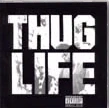
Background · Thug Life
In the fall of 1994, Tupac Shakur was caught between two court cases. The music of the group he had assembled in 1993 sounded like it: dark, defiant, often melancholy. Thug Life: Volume 1 remained the group's only album, and what came out is only part of what was originally planned.
A code for the street
For Tupac, "Thug Life" meant more than a band name. He read the term as an acronym for "The Hate U Give Little Infants Fucks Everybody": the hatred a society shows its children comes back to it later. As early as 1992, together with his stepfather Mutulu Shakur, he had drawn up a "Code of Thug Life" with rules of conduct for gangs.
The idea for the album came from Tupac, his stepbrother Mopreme Shakur and Stretch. They pictured a compilation with many like-minded rappers, a movement rather than a band. According to Big Syke, it was Interscope that suggested turning it into a fixed group while the track list was being rearranged. Tupac had to spend a long time persuading the label to sign the others, Big Syke, Mopreme and Macadoshis said in a 2016 interview with DJ Vlad.
Five men, one contract
The final lineup was five rappers: Tupac; Mopreme, previously heard as Mocedes the Mellow with Tony! Toni! Toné!; Big Syke of the Evil Minded Gangstas; and Macadoshis and The Rated R, who had performed as the duo Double Jeopardy. On July 24, 1994, the five signed with Interscope, and the album was released through Tupac's own label, Out da Gutta. The 58-page contract went up for auction at Heritage Auctions in 2018, with bidding starting at $6,000.
Recording took place between March 1993 and May 1994 in Los Angeles, at Blue Palm in North Hollywood and at Echo Sound. It was a time when Tupac shuttled between film sets and court dates: the attack on director Allen Hughes, the shooting at two off-duty police officers in Atlanta and the charges in New York all fell in these months.
What Interscope cut
The label was under political pressure over gangsta rap. Its parent company Time Warner had been cautious since the dispute over Ice-T's Cop Killer, and politicians and anti-rap campaigners were stirring things up. Interscope considered many tracks too risky, and ten remained, including two Tupac solo songs and two without him at all.
The planned first single Out on Bail was cut, even though the group had already performed it live at the 1994 Source Awards; ten years later Eminem turned it into a remix for Loyal to the Game. Runnin', featuring The Notorious B.I.G. among others, was dropped too. It came out in 1995 on the compilation One Million Strong, with the words for police blanked out. A new version with a different Tupac verse appeared in 2003 on the soundtrack to Tupac: Resurrection. Looking back in 2016, Big Syke said the original album was not what the public got to hear.
Beats by Thug Music, a lament for Kato
A large share of the beats came from "Thug Music," the name behind which Tupac and Stretch worked. The opener Bury Me a G runs on a sample of the Isley Brothers' For the Love of You, Shit Don't Stop on a loop of Parliament's Aqua Boogie, Stay True on Curtis Mayfield's Just Want to Be with You. Under Pressure is a grim back-and-forth between Tupac and Stretch.
Outside guests provided the more accessible moments. Johnny "J" produced Pour Out a Little Liquor, which had already appeared on the soundtrack to Above the Rim and is one of the best-known Thug Life songs. Warren G and Nate Dogg contributed How Long Will They Mourn Me?, a lament for Big Syke's friend Kato, who had been shot dead. Easy Mo Bee, who was working for The Notorious B.I.G. at the same time, delivered Str8 Ballin', speeding up a sample from Bootsy Collins' What's a Telephone Bill?.
Thematically the album revolves around prison, loss and loyalty. Bury Me a G and Cradle to the Grave look at a life that could end early. These are themes Tupac carried forward a few months later on Me Against the World.
Gold without promotion
The album reached No. 42 on the Billboard 200 and No. 6 on the R&B/Hip-Hop albums chart. The singles were Pour Out a Little Liquor on August 23, 1994, Cradle to the Grave on November 4, 1994, and in 1995 Shit Don't Stop (April 29) and How Long Will They Mourn Me? (July 29). On the 1995 year-end R&B/Hip-Hop albums list it placed at No. 35. On January 24, 1996, the RIAA certified it Gold for 500,000 copies.
Tupac could hardly promote it. On November 30, 1994, he was shot at Quad Studios in New York, and the next day he was found guilty of sexual abuse. After he went to prison in February 1995, the group effectively dissolved.
Hard and considered
Critics took the album more seriously than its reputation suggests. Entertainment Weekly gave it an A- in October 1994. The British magazine Select awarded four out of five in January 1995 and called it "A shockingly considered, thoughtful rap record." Q was less taken in February 1995, with three out of five stars: lots of macho posturing, broken up by soft backings from Curtis Mayfield, George Clinton and the Isley Brothers. AllMusic gave three out of five stars.
Retrospective reviews praise exactly that contrast between soft, almost tender instrumentals and hard lyrics. In 2024 Albumism wrote that even without the cut material, Thug Life remains an effective album, carried by Tupac's charisma.
Blueprint for the Outlawz
Thug Life: Volume 1 stands in the shadow of the solo albums, but fans value it. Since 1998 Amaru Entertainment, the label of Tupac's mother, has kept the album in print.
For Tupac's biography the record is an important document: it shows him as a group leader who brings friends and family to the front, a pattern he repeated after his move to Death Row with the Outlawz. A second Thug Life album never happened. More on the group can be found on the Thug Life page.