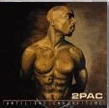
Background · Until the End of Time
29 songs on two CDs, recorded in 1995 and 1996 in the same months as All Eyez on Me and The Don Killuminati: four and a half years after Tupac's death, Until the End of Time became the first major album of unreleased material from his Death Row period. It entered straight at No. 1 and raised the question of how much of the original a posthumous release has to contain.
The fight over the tapes: Amaru and Death Row come to terms
At Death Row, Tupac had recorded far more in 1995 and 1996 than would fit on two albums. The vocal tracks run from October 14, 1995, two days after his release, to September 6, 1996, the day before the shooting in Las Vegas. After Tupac's death the tapes stayed with Death Row, while his mother Afeni Shakur fought for control of the estate.
Until the End of Time was a joint project of Afeni's label Amaru and Suge Knight's Death Row. Knight was in prison himself at the time, but is still credited as executive producer alongside Afeni. Only in three places were references to Death Row left uncensored: in the title track, in U Don't Have 2 Worry and in All Out.
New instrumentals, double versions and unborn children
Almost every song was reworked for the album, in six studios between Burbank and Hollywood. In some cases Johnny "J"'s original beats were kept, in others the instrumentals were replaced entirely. Several tracks appear on the album in two versions, such as Thug N U Thug N Me with K-Ci & JoJo, or Let 'Em Have It, once with SKG and once as a remix with Lisa "Left Eye" Lopes of TLC.
The title track with R.L. of the band Next is built on Mr. Mister's Broken Wings; a second version features vocals by Mr. Mister singer Richard Page. The Outlawz can be heard on numerous tracks, including Breathin', All Out and Runnin' on E, and Big Syke on Good Life and an interlude of his own. On Letter 2 My Unborn and Words 2 My First Born (with Above the Law, produced by DJ Quik), Tupac addresses children he never had.
Topping the Billboard 200 with 426,870 sales
The album entered the Billboard 200 at No. 1 with 426,870 copies sold and also topped the R&B/Hip-Hop and rap charts. It was the last No. 1 album Death Row released. It reached No. 2 in Canada, No. 6 in Belgium, No. 10 in the Netherlands, No. 23 in Germany and No. 31 in the UK. On the 2001 year-end list it ranked No. 40 on the Billboard 200.
Happy Home had come out in advance in December 2000. The single Until the End of Time followed on February 18, 2001 and reached No. 52 on the Hot 100, but No. 4 in the UK and No. 33 in Germany. Letter 2 My Unborn came next on June 5, 2001.
Canada certified it double Platinum in May 2001, the UK Gold in June 2001. In 2014 the RIAA certified it four times Platinum, with each CD of the double album counting separately. A frequently cited figure of "more than three million sold" could not be verified. A 20th anniversary edition was released in 2021.
Slick remixes versus the raw Death Row sound
Critics were divided; the Metacritic average stands at 51 out of 100. Entertainment Weekly and Steve Juon of RapReviews were favorable: Juon gave it eight out of ten and felt the album did Tupac justice, especially on the Johnny "J" productions, which matched his fiery style. Jon Caramanica gave it two and a half stars out of five in Rolling Stone, and AllMusic did the same. The criticism centered on the sheer volume of material and the often slick post-production in the style of 2001.
Many fans complain that the new beats water down the raw character of the Death Row originals; original versions circulate as bootlegs. At the same time, the double album was many younger listeners' first contact with Tupac. In 2014 the network BET ranked it No. 3 among the best posthumous albums. It proved that his name could still top the charts years after his death, and it marked the start of a debate about remixes that would shape how his musical legacy was handled. The next chapter was written a year later by Better Dayz.