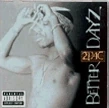
Background · Better Dayz
Up front, hard street and party tracks rule supreme, while quiet reflection takes over the back: Better Dayz drew a clear line through Tupac's Death Row archive. As the fourth posthumous studio album and second consecutive double album, the project established a firm structure that its predecessor Until the End of Time had still lacked.
Death Row Tapes Meet the Sound of the 2000s
Most of the material originated from the Death Row sessions of 1995 and 1996, with some verses tracing back to earlier recordings. Afeni Shakur and Suge Knight curated the selection together. Knight had been released from prison in the summer of 2001 and was by then calling his label "Tha Row".
Johnny "J" was once again the key producer. Joining him were contemporary figures such as Jazze Pha and T.I., who blended Tupac's voice with the Southern sound of the early 2000s.
Hard Statements on CD 1, Peace of Mind on CD 2
The first CD opens with Still Ballin' alongside Trick Daddy. This is followed by Changed Man featuring T.I. and Jazze Pha, Fuck Em All with the Outlawz, and Mama's Just a Little Girl, a story about a young mother. The disc closes with an acoustic version of Thugz Mansion featuring Nas and J. Phoenix-a posthumous duet with Nas, with whom Tupac had still been feuding in 1996.
On the second CD is the better-known version of Thugz Mansion with soul singer Anthony Hamilton: a song about a place beyond death where friends and family reunite. Never Call U Bitch Again with Tyrese, the title track Better Dayz, and Military Minds with Buckshot and the Cocoa Brovaz from New York's Boot Camp Clik demonstrate the broad musical scope of the album.
Number 5 on the Billboard 200 and Triple Platinum
Better Dayz debuted at No. 5 on the Billboard 200. Thugz Mansion reached No. 19 on the Hot 100 and No. 24 in the UK, with Still Ballin' following in 2003 as the second single. The RIAA awarded triple platinum in 2014, with each CD counted separately.
Successful Dramaturgy, Contested Post-Production
AllMusic rated the double album four out of five stars and called it the best posthumous Tupac album since his death. Entertainment Weekly, by contrast, gave it only a C.
The division into two moods is regarded as a success, while the post-production remains controversial: as with Until the End of Time, many fans prefer the original nineties beats known from bootlegs.