615 words · 3 min
Poetic Justice (1993)
John Singleton's 1993 road movie: Tupac plays mail carrier Lucky opposite Janet Jackson, his first romantic lead.
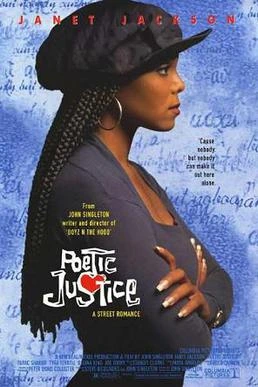
- Writer and director
- John Singleton
- Producers
- Steve Nicolaides, John Singleton
- Studio/distributor
- Columbia Pictures
- Cast
- Janet Jackson (Justice), Tupac Shakur (Lucky), Regina King (Iesha), Joe Torry (Chicago), Tyra Ferrell (Jessie), Maya Angelou (Aunt June); cameos by Q-Tip, Billy Zane and Lori Petty
- Poetry
- Maya Angelou
- Music
- Stanley Clarke
- Shot
- 1992
- US release
- July 23, 1993
- Running time
- approx. 109 minutes
- US box office
- $27.5 million; number one on opening weekend with $11.7 million (Box Office Mojo)
After Boyz n the Hood, John Singleton made a love story and cast it with pop star Janet Jackson and rapper Tupac Shakur. Poetic Justice is the first film in which Tupac plays a man who doesn’t destroy things but listens.
Credits
The story
Justice works in a hair salon in South Central Los Angeles. Since her boyfriend was shot in front of her, she has shut herself off and writes poetry. Lucky, a mail carrier and single father, flirts clumsily and gets shot down. When her friend Iesha arranges a ride to Oakland, Justice ends up sharing a postal truck with Lucky. The trip north, with detours to a family reunion picnic and an African marketplace, turns into a journey on which two wary people slowly let each other in.
How Tupac got the part
Singleton has said he wrote Justice for Janet Jackson. For Lucky he first wanted Ice Cube, who passed. In 2019 Singleton told The Daily Beast he needed someone men and women would both like, and he asked Tupac before Juice had even come out. He also advised him back then to focus on acting; Tupac shot back that hip-hop was his voice.
Talking to Right On! in 1993, Tupac summed up the difference from his Juice role: Bishop is on the edge and can’t deal with it, Lucky is doing his best to deal with it.
Janet Jackson and the “AIDS test” story
For decades a story has circulated that Janet Jackson demanded Tupac take an HIV test before a kissing scene. Singleton told it differently in 2019: he himself joked on set that Tupac would need an AIDS test before kissing “his” leading lady, and the joke turned into publicity. In a 1996 radio interview Tupac said Jackson had met him when he was still very immature; he wasn’t mad at her and wanted the chance to make things right.
Release and reviews
At launch, the Cineplex Odeon chain refused to show the film at its Universal CityWalk theater for fear of violence, which drew accusations of racism. Variety later reported five violent incidents around theaters on opening weekend, including a fatal shooting in a Las Vegas parking lot.
Reviews were mixed, but Tupac mostly came off well. Leonard Klady of Variety wrote that Shakur “has the juicier part and turns in truly outstanding work.” Vincent Canby of The New York Times found Jackson’s Justice passive and the characters around her, Lucky first among them, “far more believable.” Kenneth Turan of the Los Angeles Times called the film a disappointment but praised both leads. Roger Ebert gave it three stars out of four. Janet Jackson’s song Again from the film earned an Oscar nomination.
Soundtrack
The soundtrack came out on Epic in 1993. Tupac contributed Definition of a Thug Nigga, which later also appeared on the 1997 album R U Still Down? (Remember Me). More in the discography.
What came next
Singleton also wanted Tupac for his next film, Higher Learning (1995). It didn’t happen, in a 1995 Vibe interview Tupac said Singleton had fired him from it. The two remained connected, and after Tupac’s death Singleton spoke about him repeatedly. In Germany the film kept its original title.