1,528 words · 7 min
Poetic Justice (1993)
John Singleton's 1993 road movie: Tupac plays the mail carrier Lucky opposite Janet Jackson, his first romantic lead role.
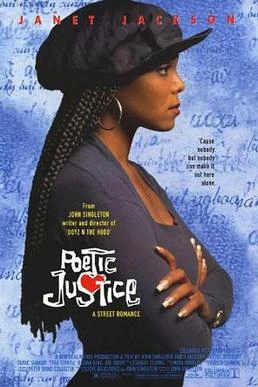
- Writer and director
- John Singleton
- Producers
- Steve Nicolaides, John Singleton
- Studio/distributor
- Columbia Pictures
- Cast
- Janet Jackson (Justice), Tupac Shakur (Lucky), Regina King (Iesha), Joe Torry (Chicago), Tyra Ferrell (Jessie), Maya Angelou (Aunt June); in cameos Q-Tip, Billy Zane and Lori Petty
- Poems
- Maya Angelou
- Cinematography
- Peter Lyons Collister
- Music
- Stanley Clarke
- Filmed
- from spring 1992 in Southern California, including in Simi Valley
- U.S. release
- July 23, 1993, on 1,273 screens
- Running time
- approx. 109 minutes, rated R
- U.S. box office
- $27.5 million; No. 1 on opening weekend with $11.7 million (Box Office Mojo, Los Angeles Times)
After Boyz n the Hood, John Singleton made a love story and cast pop star Janet Jackson and rapper Tupac Shakur in it. Poetic Justice is the film in which Tupac for the first time plays a man who doesn’t destroy but listens. It was shot in the spring of 1992, while Los Angeles was burning; in the summer of 1993, the film topped the U.S. box office.
Key Facts on the Film
The Story
Justice works in a hair salon in South Central Los Angeles. Since her boyfriend was shot in front of her, she has shut herself off and writes poetry. Lucky, a mail carrier and single father, flirts clumsily with her and gets shot down. When her friend Iesha arranges a ride to Oakland, Justice ends up, of all people, with Lucky in the mail truck. The four’s trip north, with detours to a family picnic and an African marketplace, becomes a journey on which two wary people grow closer. In Oakland, Lucky learns that his cousin, with whom he was recording music, has been shot dead; only months later do he and Justice find their way back to each other.
Written for Janet: How the Film Came About
After the success of Boyz n the Hood, for which he had become the youngest director ever and the first African American to receive an Oscar nomination for directing, Singleton wanted to tell a story from the point of view of a young Black woman. Films with Black female leads were rare at the time. Many well-known actresses came to audition, but Singleton told Essence in 2013 that he had written the role for Janet Jackson from the start. At their very first meeting, he said, he told her he wanted to make his next film with her.
According to Singleton, the braids that made Jackson’s character famous came about together with Jackson, choreographer Fatima Robinson and dancer Josie Harris, who had worn the hairstyle in Michael Jackson’s video Remember the Time; Singleton had directed that video. “We got the hairstyle from Harlem and just put it in a West Coast movie,” he said. The poems Justice recites in the film were written by Maya Angelou, who also appears in it herself.
How Tupac Got the Part
For Lucky, Singleton first had Ice Cube in mind, who turned it down. Singleton told The Daily Beast in 2019 that he needed a man whom men and women liked equally, and that he asked Tupac before Juice had even come out. He even advised him back then to focus entirely on acting; Tupac answered that hip-hop was his voice.
In 2013, Singleton remembered a young man who was constantly cracking jokes on set: Tupac was “so funny,” and only later did he get dark. He described him as a brilliant but confused kid with a lot of fame and no father, who had no one to set limits for him. But when you did, he said, Tupac respected it.
Shooting While the City Burned
Filming was under way when unrest broke out in Los Angeles in April 1992 after the acquittal of the police officers in the Rodney King case. Singleton told Essence that the crew was shooting in Simi Valley that day. He himself arrived late on set because he had gone to the courthouse and protested. When he got there, the crew was following the news on a small TV, and some predicted the city would burn. “And it happened,” Singleton said. Shooting continued nonetheless. In the finished film, burnt-out corners of South Central can be seen in passing, as Kenneth Turan noted in his review.
On set, according to Singleton, all the men had a bit of a crush on Janet Jackson and flirted with her, not knowing she was secretly married to René Elizondo. Himself included.
Janet Jackson and the “HIV Test” Story
For decades, a story has circulated about the shoot that Janet Jackson demanded an HIV test from Tupac before a kissing scene. Singleton told it differently in 2019: he himself had joked on set that Tupac needed an AIDS test before he could kiss “his” leading lady. The joke turned into publicity.
Release: No. 1 and a Debate About Violence
At the release, the Cineplex Odeon chain refused to show the film at its theater at Universal CityWalk for fear of violence; two years earlier, there had been shootings there at the opening of Boyz n the Hood. That earned the chain accusations of racism, and at the request of Councilwoman Rita Walters, the Los Angeles City Council called the decision “racist.” Mayor Richard Riordan, on the other hand, said the company should not be condemned for it. From the following Wednesday, the film played there too.
At the box office, the combination of a pop star and an Oscar-nominated director paid off. On its first weekend, Poetic Justice took in $11.7 million on 1,273 screens and knocked Tom Cruise’s The Firm off the No. 1 spot after three weeks. Boyz n the Hood had opened two years earlier with $10 million without reaching the top. The distributor reported that the film was playing as well in predominantly white neighborhoods as in the inner cities. In total, it made $27.5 million in the U.S.
Two weeks later, Variety reported five violent incidents around theaters on the opening weekend. In Las Vegas, a 21-year-old man was shot dead in his car in a theater parking lot after the opening-night show; the police said explicitly that they could not say whether the crime had anything to do with the film, and nothing had happened inside the theater. In Knoxville, a moviegoer was shot in the leg after the show, in Chicago there was a fistfight in the auditorium, and a theater in Joliet canceled all late screenings.
Reviews at the Time
The reviews were mixed, but Tupac mostly came off well. Leonard Klady (Variety) wrote that Shakur had the more rewarding role and delivered “truly outstanding work.” Vincent Canby (New York Times) found Jackson’s Justice pale, but the characters around her, above all Lucky, “far more believable.” Kenneth Turan (Los Angeles Times) called the film a disappointment that felt thrown together, but praised both leads. Peter Travers (Rolling Stone) saw in Jackson a “refreshingly unslick” newcomer and called Lucky “forcefully played” by Shakur. Roger Ebert gave it three out of four stars: not a second Boyz n the Hood but a softer, gentler film, more romance than social commentary; by the end, Lucky has learned to listen to a woman.
Janet Jackson’s song Again from the film was nominated for an Oscar. At the same time, Jackson received the Golden Raspberry for Worst New Star in 1994 and a nomination for Worst Actress.
The View Today
Over the years, the verdict has grown kinder. Writing at Vulture in April 2019, Bilge Ebiri argued that Poetic Justice could be considered an even greater work than Boyz n the Hood. He praised a “marvelous” Janet Jackson and an “electrifying” Tupac Shakur and highlighted a small scene: Justice looks up from her poem and remarks on how dirty Lucky’s fingernails are, and he responds with quiet shame disguised as indifference. Ebiri called Jackson’s Razzie nomination a reason to burn the Golden Raspberries to the ground.
In April 2026, the Criterion Collection released Poetic Justice in 4K together with Boyz n the Hood and Baby Boy as John Singleton’s Hood Trilogy. It was the first time a film featuring Tupac appeared in the Criterion Collection, which is regarded as a canon of cinema.
Soundtrack
The soundtrack came out in 1993 on Epic. Tupac contributed Definition of a Thug Nigga, which also appeared in 1997 on the album R U Still Down? (Remember Me). More in the Discography.
What Came Next
Singleton also wanted Tupac for his next project, Higher Learning (1995). It didn’t happen; in a 1995 Vibe interview from prison, Tupac said Singleton had fired him from Higher Learning and given his idea to the next actor. The friendship held anyway. Singleton said in 2013 that he met Tupac a week and a half before Tupac’s trip to Las Vegas and told him about a new film project that later became Baby Boy (2001): this, he said, would be the film to win him an Oscar. Tupac agreed to do it. He was going to be “my Robert De Niro,” Singleton said. In Germany, the film was released under its original title.
People in this text