1,362 words · 6 min
Nothing but Trouble (1991)
A brief court appearance and the first rap on record: how Tupac landed in theaters in 1991 with Digital Underground in Dan Aykroyd's "Nothing but Trouble."
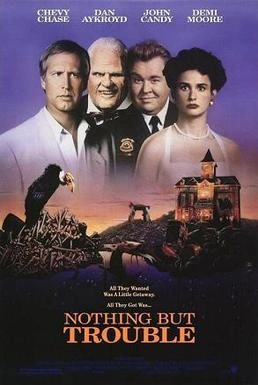
- Director and screenwriter
- Dan Aykroyd (directorial debut), based on a story by Peter Aykroyd
- Producer
- Robert K. Weiss
- Studio/distributor
- Warner Bros.
- Cast
- Chevy Chase (Chris Thorne), Demi Moore (Diane Lightson), John Candy, Dan Aykroyd (Judge Alvin Valkenheiser); as themselves: Digital Underground with Shock G, Money-B and 2Pac
- Cinematography
- Dean Cundey
- Music
- Michael Kamen
- Working titles
- Git, then Valkenvania
- Filmed
- from May 7, 1990, in Los Angeles, mostly on sets on the Warner Bros. Studios lot
- U.S. release
- February 15, 1991 (originally planned for December 1990)
- Running time
- 93 minutes according to the AFI Catalog, rated PG-13
- Budget
- $40 million according to Box Office Mojo; other figures go as high as $45 million
- U.S. box office
- $8.48 million, including $3.97 million on opening weekend (Box Office Mojo)
His first big-screen appearance lasted only a few moments. A year before his first starring role in Juice, Tupac Shakur appeared in 1991 as a member of Digital Underground in Dan Aykroyd’s comedy Nothing but Trouble. In Germany, the film was released as Valkenvania, Die wunderbare Welt des Wahnsinns. The film itself became an expensive flop. For Tupac, it was the moment the roadie and dancer of a party band turned into a rapper with his own verse on record and a face on the movie screen.
$40 Million Budget: Key Facts on the Film
From the Working Title “Git” to “Nothing but Trouble”: How It Came About
The idea came from Dan Aykroyd’s brother Peter: city folk run into a rural judge who sentences traffic offenders by his own laws. Aykroyd turned it into a screenplay and directed for the first time. He played two roles himself, including the ancient judge under a thick layer of makeup.
The title changed twice. According to the AFI Catalog, which draws on Daily Variety, the project was first called Git; in July 1990 it became Valkenvania. In December 1990, Warner Bros. renamed the film Nothing but Trouble. Aykroyd responded in a short statement that he would always think of the film as Valkenvania. In Germany, that name survived in the title. The end credits include a thank-you to John Hughes.
Scrapyard Garden and Haunted House: The Shoot in the Summer of 1990
Filming began on May 7, 1990, in Los Angeles. The judge’s rambling estate, the town hall and the surroundings were built on two soundstages at Warner Bros. Studios. According to the AFI Catalog, the crew pulled props from every prop house in town and from Aykroyd’s own collection. Production designer William Sandell, who had once built kinetic sculptures, designed a sculpture garden made of car wrecks for the film, which the crew called “Autohenge.”
The New York apartment of Chevy Chase’s character was shot at Greystone Mansion in Beverly Hills. In late August 1990, the Allentown newspaper Morning Call reported on filming in the Lehigh Valley in Pennsylvania; a second unit shot in Pennsylvania, New Jersey and New York City.
De La Soul Were on Tour: A Fake Nose Won Aykroyd Over
Shock G told Rolling Stone in 2017 how the job came about: Aykroyd liked to put musicians in his films and actually wanted De La Soul, but the group was on tour in Europe at the time. The label, Tommy Boy, then sent press material on other acts, and Aykroyd’s eye stuck on the photo of Shock G’s alter ego Humpty Hump with the fake nose.
Shortly afterward, the director suddenly turned up in the dressing room at one of the band’s shows at the Palace in Los Angeles. It was midsummer, The Humpty Dance was everywhere, and by Shock G’s recollection about 30 people were crammed into a room built for 15, Eazy-E among them. Only when Shock G turned around did he notice who was sitting next to him. There, Aykroyd offered the group the scene. Later he called Shock G in Oakland: the band should play themselves, there should be an organ in the song, and they should simply rap “that same song” they already had. Shock G took the remark literally, and that is how the title Same Song came about.
The First Rap on Record: One Line in Front of the Camera
In the film, Digital Underground also get pulled over in Valkenvania and end up in front of Judge Valkenheiser. To prove they really are musicians, they play a number in the courtroom. The judge is delighted and, according to the AFI Catalog, lets them go without a fine. The group also performs Tie the Knot in the film.
According to the AFI Catalog, Greg Jacobs (Shock G), Ron Brooks (Money-B) and 2Pac Shakur wrote Same Song together, with Shock G producing. It was Tupac’s first released rap verse; the single came out in January 1991 on Tommy Boy. The recording was rushed: Shock G played the beat to the others over the phone, and the band members heard each other’s verses for the first time in the studio. “All the good shit is rushed,” he said. In the music video, which is set at a drive-in and shows scenes from the film, Tupac appears in the final verse as an African king, and Aykroyd makes several cameos.
Band member Fuze told Rolling Stone about the film scene: “That was Tupac’s first acting. I think Pac said one thing.” Money-B got his membership in the actors’ union SAG because of the shoot. Chopmaster J summed up the path: Tupac went “from roadie to movie star in less than a year.”
More on Same Song and the years with the band can be found in the Discography and on the page about Digital Underground.
Pushed Back and Flopped: Release and Box Office
Warner Bros. first wanted to release the film in December 1990 but, according to an item in Variety dated December 24, 1990, moved the release to February 1991. Nothing but Trouble opened in U.S. theaters on February 15, 1991. It took in just under $4 million on its first weekend and $8.48 million in the U.S. overall. That left it far short of its budget of around $40 million.
Panned by Critics: Voices at the Time
The film failed with critics and audiences alike. According to the AFI Catalog, the New York Times faulted the plot’s loose ends, and the Hollywood Reporter the skit-level humor. Variety wrote that Aykroyd used to parody this kind of excess in his sketches on Saturday Night Live; the high point, it said, was seeing John Candy in drag.
In the Los Angeles Times, Peter Rainer compared the film to a cross between Psycho and Abbott and Costello Meet Frankenstein. Anyone in the mood to be clobbered with stale jokes, he wrote, might find it “fitfully amusing.” Aykroyd himself as the smarmy judge and Candy in his double role were the bright spots. The German Lexikon des internationalen Films also called it a disappointing attempt at directing.
In March 1992, Aykroyd received the Golden Raspberry for Worst Supporting Actor for the role, as UPI reported.
A Flop with a Find: The View Today
The verdict has hardly softened over the years. In 2007, Nathan Rabin included the film in his My Year of Flops series at The A.V. Club and called it a “spectacular” failure for which Aykroyd, as writer, director and star, had only himself to blame. Of all things, he wrote that the band’s cameo was the only time he came close to laughing: when Digital Underground call the judge’s estate “extremely draculated.” He dryly described the young man at the edge of the group as a hanger-on who would later go on to “a little bit of fame” as 2Pac.
What It Meant for Tupac
For Tupac fans, Nothing but Trouble is a find: it is the first time he can be seen on a movie screen, and Same Song is his first released verse. A year later, he was already playing a lead role in Juice. The courtroom scene in Valkenvania still shows him as part of a group, shortly before he stepped out of its shadow with records and roles of his own.
People in this text