602 words · 3 min
Nothing but Trouble (1991)
A brief court appearance and the first rap on record: How Tupac landed in theaters in 1991 with Digital Underground in Dan Aykroyd's "Nothing but Trouble."
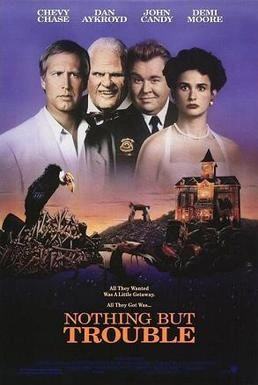
- Director and screenwriter
- Dan Aykroyd (directorial debut), based on a story by Peter Aykroyd
- Producer
- Robert K. Weiss
- Studio/distributor
- Warner Bros.
- Cast
- Chevy Chase (Chris Thorne), Demi Moore (Diane Lightson), John Candy, Dan Aykroyd (Judge Alvin Valkenheiser); as themselves: Digital Underground
- Cinematography
- Dean Cundey
- Music
- Michael Kamen
- Filmed
- starting May 1990, mostly on sets on the Warner Bros. Studios lot
- US theatrical release
- February 15, 1991 (originally planned for December 1990)
- Running time
- approx. 94 minutes
- US box office
- $8.5 million, of which $4.0 million was from opening weekend (The Numbers); the budget is reported as $40 to $45 million depending on the source
His first big-screen appearance lasted only a few moments. A year before his first starring role in Juice, Tupac Shakur appeared in 1991 as a member of Digital Underground in Dan Aykroyd’s comedy Nothing but Trouble. In Germany, the film was released as Valkenvania, Die wunderbare Welt des Wahnsinns.
$40 Million Budget: Key Facts on the Film
Speeding in Valkenvania: Acquittal by Jam Session
Four New Yorkers, centered around a financial publisher (Chevy Chase) and a lawyer (Demi Moore), take a drive through the countryside, get caught in a traffic stop in the small town of Valkenvania, and end up before the ancient Judge Valkenheiser. On his bizarre estate, he hands down draconian punishments to traffic violators.
Digital Underground end up in the courtroom as well: the band was also caught speeding and is ordered to prove they are truly musicians. The group spontaneously plays a song, the judge is thrilled, and he acquits them.
De La Soul Were on Tour: A Fake Nose Convinced Aykroyd
Shock G recounted in Rolling Stone in 2017 how the gig came about: Aykroyd originally wanted De La Soul, but the group was touring Europe at the time. Their record label Tommy Boy then sent press kits for other acts, and Aykroyd was hooked by the photo of Shock G’s alter ego Humpty Hump with the fake nose.
The director attended a concert, sat with the band in their dressing room afterward, and offered them the scene. For the song, he requested an organ and suggested they simply play “the same song” they already had anyway. Shock G took the remark literally-and that is how the title Same Song came to be.
The First Rap on Record: One Line in Front of the Camera
According to the AFI Catalog, Greg Jacobs (Shock G), Ron Brooks (Money-B), and 2Pac Shakur wrote the track Same Song together. It was Tupac’s first released rap verse; the single came out in January 1991. In the music video, which incorporates scenes from the film, Tupac appears as an African king, while Aykroyd himself makes a cameo appearance.
Band member Fuze told Rolling Stone about the movie scene: “That was Tupac’s first acting. I think Pac had one line.” Money-B earned his membership in the Screen Actors Guild (SAG) through the shoot.
More on Same Song and the years with the band can be found in the discography and on the page for Digital Underground.
Panned by Critics, a Find for Fans
The film was a flop with both critics and audiences. Variety wrote that Aykroyd would once have parodied this kind of wretched excess in his sketches on Saturday Night Live; the highlight was seeing John Candy in drag. The Lexikon des internationalen Films likewise described it as a disappointing directorial effort.
For Tupac fans, Nothing but Trouble remains a find nonetheless: it is the first time he can be seen on a movie theater screen-a year before Juice made him known.
People in this text