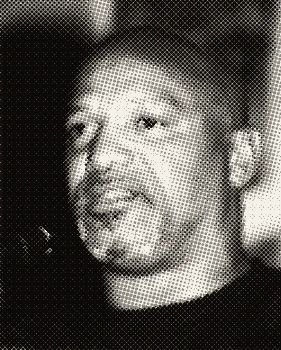
Elmer “Geronimo” Pratt was Tupac’s godfather, and one of the best-known cases of political miscarriage of justice in the United States. He spent 27 years in prison for a murder. Then a court overturned the verdict because the prosecution had concealed crucial information about its key witness.
Soldier and Panther
Pratt was born on September 13, 1947, in Morgan City, Louisiana. His father was in the scrap-metal business; the son played quarterback for his high school team. In the Army he served two tours in Vietnam, was decorated several times, including two Purple Hearts, and came home a sergeant.
Using the GI Bill, he studied political science at the University of California, Los Angeles. There the Panthers Bunchy Carter and John Huggins recruited him into the Black Panther Party. After both were shot dead on campus in January 1969, Pratt rose to lead the Panthers in Los Angeles. He rejected the name Elmer and called himself Geronimo, after the Apache leader, and ji-Jaga. He is sometimes described as “minister of defense of the entire organization”in fact he led the Los Angeles chapter.
In the FBI’s sights
The FBI regarded the Panthers as a threat to national security. Internal documents of its COINTELPRO counterintelligence program speak of “neutralizing” Pratt as an “effective” party functionary.
The Santa Monica murder
On December 18, 1968, two armed men held up elementary school teacher Caroline Olsen, 27, and her husband Kenneth on a tennis court in Santa Monica. They took $18 and shot both of them. Kenneth Olsen survived; his wife died eleven days later. (The crime is sometimes wrongly placed in 1986.)
Pratt was charged and on July 28, 1972, convicted of first-degree murder and sentenced to life. The case against him rested on Kenneth Olsen’s identification, the testimony of former Panther Julius Butler that Pratt had confessed to him, and evidence linking him to the weapon and the getaway car. Pratt insisted he had been at a Panther meeting in Oakland at the time, more than 300 miles away. His lawyer was Johnnie Cochran, who later became famous for the O. J. Simpson trial.
27 years behind bars
Pratt spent eight of his 27 years in prison in solitary confinement. The parole board turned him down 16 times. Bit by bit, it emerged what the jury had not known: Kenneth Olsen had earlier identified another man. Julius Butler had been an informant for the FBI and the police and had denied it under oath. FBI wiretap logs that might have supported Pratt’s alibi had vanished from the files.
Freedom and compensation
On June 10, 1997, Judge Everett W. Dickey of the Orange County Superior Court vacated the conviction because the prosecution had concealed that its key witness was an informant. Pratt walked free after 27 years. California lost its appeal in 1999, and prosecutors decided against a retrial. Shortly after his release, Pratt traveled to Morgan City to see his mother, whom he had not seen in more than 20 years.
In 2000 he received $4.5 million in a settlement: $2.75 million from the City of Los Angeles and $1.75 million from the U.S. Department of Justice. He would have preferred a trial to expose the authorities’ “evil scheme,” but followed his lawyers’ advice.
Tupac’s godfather
Pratt was part of the Panther family Tupac was born into. As early as 1997, Vanity Fair explicitly called him Tupac’s godfather. When Tupac died in 1996, Pratt was still in prison. In his 1997 letter to the Wallace family, Mutulu Shakur pointed to the Pratt trial to show how the authorities had acted against the movement: he himself had researched COINTELPRO for Pratt’s defense.
Later years
After his release, Pratt campaigned for people he believed had been wrongly convicted, among them Mumia Abu-Jamal. He later moved to Tanzania, where he had friends. He died there, in the village of Imbaseni, on June 2, 2011, at the age of 63.