1,105 words · 5 min
Gang Related (1997)
Tupac's last film: shot in Los Angeles in August 1996, released in 1997. He plays a corrupt homicide detective alongside James Belushi.
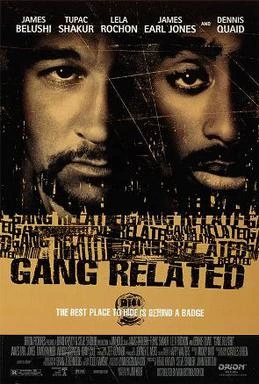
- Writer and director
- Jim Kouf
- Producers
- Brad Krevoy, Steve Stabler, John Bertolli; executive producer Lynn Bigelow-Kouf
- Studio/distributor
- Orion Pictures; distributed in the U.S. by MGM
- Cast
- James Belushi (Frank Divinci), Tupac Shakur (Jake Rodriguez), Lela Rochon (Cynthia), Dennis Quaid (Joe), James Earl Jones (Arthur Baylor), David Paymer, Wendy Crewson, Gary Cole, Kool Moe Dee
- Cinematography
- Brian J. Reynolds
- Music
- Mickey Hart
- Filmed
- August 1996 in Los Angeles
- U.S. release
- Wednesday, October 8, 1997 (AFI Catalog: Los Angeles opening on Oct. 8, New York the same week; Box Office Mojo lists Friday, October 10, as the date of the opening weekend)
- Running time
- approx. 106-111 minutes
- U.S. box office
- $5.9 million; $2.4 million on opening weekend in 1,260 theaters (Box Office Mojo)
- Germany
- Gangland, Cops unter Beschuß, video premiere on August 14, 1998

Gang Related is the last film Tupac Shakur made. Filming in Los Angeles ended a few days before the shooting in Las Vegas. Tupac plays Jake Rodriguez, a homicide detective who robs and kills drug dealers with his partner until the two accidentally kill an undercover agent. For the first time in a film he is on the side of the law, and of all roles, here he plays a man who pronounces himself guilty.
Key Facts on the Film
The Story
Detectives Divinci and Rodriguez have a lucrative system: they pose as buyers, shoot the dealers and make it look like a gang killing. They keep the money and the drugs. Rodriguez goes along because he has gambling debts. When their next victim turns out to be an undercover DEA agent, they need a scapegoat. They find one in a homeless man who turns out to be someone else entirely. From then on, the noose around the two tightens ever further.
“Gang Related”: The Idea Behind the Film
Jim Kouf had previously written cop movies like Stakeout, in which the police were the good guys. For Gang Related he turned that around. In a 2018 interview he called the film a “grim farce” about reality and memory and how easily both can be manipulated. The title picks up a formula of those years: “gang related,” he said, served at the time as the explanation for a lot of killing on the streets. Nobody expects such a case to be solved, and the two cops in the film exploit exactly that indifference.
The film was produced for Orion Pictures. At its screening in Cannes, Variety called Gang Related a “holdover” Orion feature. MGM eventually brought it to theaters.
The Last Days of Shooting
According to Vibe, Tupac was still shooting Gang Related two weeks before his death; during a break in filming, he talked with journalist Rob Marriott in his trailer, one of his last major interviews. Kouf said Tupac was killed ten days after filming wrapped.
The start was bumpy. Jim Belushi told The Seattle Times that Tupac was late on the first day of rehearsals, didn’t show up at all on the second and was late again on the third. Belushi confronted him: if he was late again the next day, he needn’t bother showing up at all. A heated argument followed. Tupac said he hadn’t been able to find a parking space. When his bodyguards moved closer, he sent them back: this was between him and Jim. After that, Belushi said, Tupac was there “in every way,” and the two had great chemistry. Belushi introduced him to the music of Frank Sinatra on set. Tupac loved it, listened to a lot of Sinatra and planned a rap version of Fly Me to the Moon.
Lela Rochon remembered “an eerie feeling” on set. She hadn’t believed the film would get finished. Tupac usually brushed it off and said he would be fine, but he also told her he expected to die young. She kept telling him he was in the best position anyone could be in: stars like Denzel Washington and Wesley Snipes were getting older, and hardly anyone was as photogenic as he was at 25. “I don’t think he heard me,” she said.
Director Jim Kouf said in 2018 that Tupac was great to work with and saw acting as a way out of the music world, which was controlling his life at the time. He was also going to score the film. They had a lot of fun on set. In a promotional interview from August 1996 that MGM later sent out, Tupac said he could act because he could go “to that true place” inside himself.
Release and Box Office
More than a year after Tupac’s death, Gang Related opened on October 8, 1997, in 1,260 U.S. theaters. It took in $2.4 million on its first weekend and just under $6 million in total. In Germany the film was not released in theaters but went straight to video in August 1998.
Reviews
Variety saw the film as early as May 1997 at the market in Cannes: a good, complex story that goes too far at the end. The premise holds interest for a long time, the gray zone between police and crime is intriguingly explored, and the script is neatly structured, even if the dialogue is almost comically overloaded with profanity. Belushi’s character, the review said, becomes too much of a mere ranter toward the end. Tupac was “impressive” in his final role as a man undone by his own conscience; his line “I deserve to die” would ring hauntingly with audiences. The Death Row soundtrack adds power to the film. The film is dedicated to Tupac.
In Germany, film-dienst called it a gripping, carefully crafted cop and gangster film that nonetheless lacks psychological depth. On Rotten Tomatoes, Gang Related today stands at a mixed 52 percent.
Soundtrack
The soundtrack came out on October 7, 1997, as a double album on Death Row Records. Tupac appears on four songs, including Starin’ Through My Rear View, Made Niggaz and Lost Souls with the Outlawz; other contributions come from Daz Dillinger, Nate Dogg and Ice Cube, among others. The song Fortune and Fame, which Tupac mentioned in the promotional interview, is not on the album. More in the Discography.
Assessment
After Bullet and Gridlock’d, Gang Related was the third and last film released after Tupac’s death. It shows him on the side of the law for the first time, as a cop who has long since crossed over to the other side. His colleagues remembered a focused, friendly Tupac who saw acting as his future. How Tupac’s path ended in September 1996 is described on the page Death.
People in this text