1,139 words · 5 min
Bullet (1996)
Shot in Brooklyn in 1994, released only after Tupac's death: in Julien Temple's gangster drama he plays the one-eyed gang leader Tank.
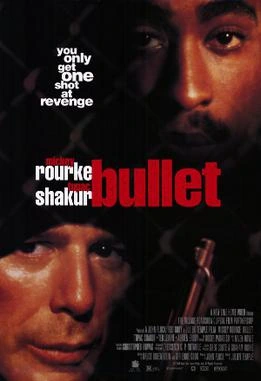
- Director
- Julien Temple (previously Absolute Beginners and Earth Girls Are Easy)
- Screenplay
- Bruce Rubenstein and “Sir Eddie Cook,” a pseudonym of Mickey Rourke
- Producer
- John Flock; Village Roadshow / Clipsal Films
- U.S. distributor
- New Line Cinema
- Cast
- Mickey Rourke (Butch “Bullet” Stein), Tupac Shakur (Tank), Adrien Brody (Ruby Stein), Ted Levine (Louis Stein), John Enos III (Lester), Donnie Wahlberg, Suzanne Shepherd, Jerry Grayson; in early small roles Michael Kenneth Williams and Peter Dinklage
- Cinematography
- Crescenzo G. P. Notarile
- Music supervision
- Randall Poster
- Filmed
- 1994 in New York, mostly in Brooklyn; copyright year 1995
- Release
- Wikipedia and film databases list a limited U.S. release in October 1996 (date given there: October 1, 1996), one month after Tupac’s death. Variety wrote in spring 1997 that the film was already on video shelves in the U.S. and reviewed its belated theatrical release in Australia.
- Running time
- 93 minutes according to Variety (other figures up to 96 minutes)
- German title
- Bullet, Auge um Auge

Bullet is the least known of Tupac’s feature films. Shot in New York in 1994, it sat on the shelf for years and came out only after Tupac’s death, with almost no promotion and, in the U.S., essentially on video. Tupac plays Tank, a one-eyed gang leader from Brooklyn and Mickey Rourke’s antagonist. Behind the small, rough film lies a shoot that director Julien Temple described a quarter century later as one of the strangest of his career.
Key Facts on the Film
The Story
Butch Stein, known as Bullet, returns after eight years in prison to his Jewish family in Brooklyn: to his elderly parents, his younger brother Ruby, who paints murals, and his older brother Louis, a traumatized Vietnam veteran. Butch immediately falls back into old patterns, heroin and petty crime. In the process he clashes with Tank, who rules the neighborhood as a gang leader and still has a score to settle with Butch. The conflict ends fatally for several of the main characters.
A Brooklyn Story: How the Film Came About
According to Temple, the screenplay is based on a true story: co-writer Bruce Rubenstein told the life of his own brother, a Jewish small-time criminal from Brooklyn who was called “Bullet.” Rubenstein later worked for Mickey Rourke, and the two wrote the script together over a long period. The film was made on a small budget; the Australian company Village Roadshow was still small at the time. The real coup of the casting, Temple said, was not Rourke but Tupac: “He was something else at that point.”
Shakespeare at the Audition
A casting agent brought up Tupac’s name. Temple met him one afternoon in an empty restaurant downtown. Tupac was very keen, he said, and auditioned by performing Shakespeare. Temple was thrilled. On set, Tupac was a subtle actor interested in the craft; when they improvised, Temple always liked what Tupac came up with, a line like “You smell like wet dog,” for instance. Tupac knew exactly whom he was playing and made intelligent choices.
A Shoot Under the Elevated Tracks
Most of the filming took place in Brooklyn, in south Williamsburg under the elevated J, M and Z subway lines, plus a funeral scene at Calvary Cemetery in Queens. Even the location scouting took the crew through Bed-Stuy and out to Coney Island. A film about a Jewish gangster met with resistance in Brooklyn: when the crew shot in Williamsburg during a holiday, thousands of Hasidic men, as Temple remembers it, lined the streets to stop the shoot.
One of the first scenes with Tupac was a drug deal in a housing project. As dusk fell, shots suddenly rang out from the roof; teenagers wanted to drive the film crew away. Temple knocked on Tupac’s trailer. Tupac came out and shouted up that it was him, Tupac. Up on the roof, nobody believed him at first, until he started rapping. Only then did the teenagers come down.
Tupac’s reputation followed the whole shoot. Temple said Tupac had a calming effect on Rourke, who was in a deep personal crisis at the time, and that Rourke was suddenly no longer the “baddest” guy on set. Wherever they shot, Tupac was mobbed by fans. With the New York police, whom the crew paid to close off streets, there was constant trouble: in Temple’s view, the officers deliberately let trucks drive through takes, and many takes were lost for sound as a result. Temple shared a trailer with Tupac and his people, who played loud music and danced during breaks. He later also visited Tupac in jail.
Mickey Rourke and Tupac
Tupac shared a friendship with Mickey Rourke that went beyond the shoot. In his Vibe interview from prison in spring 1995, Tupac counted Rourke among the people who stood by him during that time. Rourke simply became his friend, not as a white man with a Black man, but “friend to friend.”
Recut and Rescored: The Fight over the Version
After the shoot, Temple edited the film. He then learned that a tamer cut was being made in parallel in Los Angeles; he says he won that battle. The music he had chosen, however, was removed entirely. He had to work from a list of cheaper tracks the production was willing to pay for. What survived was mainly a Barry White song that the actors sing along to in one scene; at the end, a remix of Jay-Z’s In My Lifetime plays. Hardly anyone cared about the release; the film was “aborted at birth,” Temple said.
Release and Reviews
The film only came out once Tupac was dead, and even then only on the margins. Variety reviewed it in March 1997 after a screening in Sydney, where Village Roadshow belatedly put it into a few theaters. Bullet received little praise. Variety called the film grungy, downbeat and uninvolving, the screenplay listless and Rourke’s performance tired; the dialogue, it said, was often so mumbled it was hard to decipher. At most, fans of the late Tupac Shakur, who is second-billed, might check it out, the trade paper said. No box office figure has been recorded.
A quarter century later, the film found an advocate: in 2021, critic Steve Macfarlane called Bullet a mean, repugnant and violent film with moments of “sublime” beauty, not perfect but impossible to forget. At the time, it could only be seen on old videotapes and DVDs.
Assessment
Bullet was made in 1994, one of the most difficult years of Tupac’s life: in March, Above the Rim opened, the sexual abuse trial loomed in New York, and in November he was shot at Quad Studio (see Trials and The 1994 Shooting in New York). By the time the film finally came out, Tupac was dead. That makes Bullet the first of three films released posthumously; Gridlock’d and Gang Related followed.
More pictures

