629 words · 3 min
Dear Mama: The Saga of Afeni and Tupac Shakur (2023)
Two lives in parallel: Allen Hughes edits Afeni Shakur's Panther years and Tupac's rise into a five-part FX docuseries. On Disney+ in Germany.
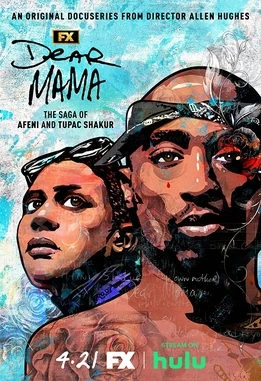
- Director
- Allen Hughes; screenplay by Hughes and Lasse Järvi
- Scope
- five episodes of roughly 50 to 66 minutes each
- Premiere
- April 21, 2023, on FX, the following day on Hulu
- In Germany
- available on Disney+
- Music
- Atticus Ross, Leopold Ross, and Claudia Sarne
- Production
- among others Amaru Entertainment, Defiant Ones Media Group, MACRO, and Interscope Films; executive producers include Jamal Joseph, Quincy Jones III, and author Staci Robinson
Two biographies, told in parallel: Dear Mama places Tupac’s life path alongside that of his mother, Afeni Shakur. Director Allen Hughes jumps back and forth across the decades, showing how deeply the Black Panther activist’s history shaped her son’s life. The series takes its title from Tupac’s 1995 song Dear Mama.
Five Episodes Between FX and Disney+
The project was announced in 2019 under the working title Outlaw: The Saga of Afeni and Tupac Shakur.
From the Panther 21 Courtroom to the Rap Stage
In New York, Afeni Shakur was among the leading voices of the Black Panther Party. As one of the “Panther 21,” she was accused of conspiring against the state. She spent a large part of her pregnancy in custody, defending herself in court without any legal training. Later, she struggled with drug addiction, which shaped the lives of her children. The series chronicles these years in parallel with Tupac’s journey from drama student to rap star to his death in 1996.
Featured voices include family members such as Tupac’s aunt Gloria Cox and his biological father Billy Garland, former Panthers like Jamal Joseph, Tupac’s first manager Leila Steinberg, and his drama teacher. Snoop Dogg, Dr. Dre, and Mike Tyson also speak on camera. In addition, Hughes announced previously unreleased audio and video material.
Fired from “Menace II Society”: Hughes in Front of His Own Camera
The director has his own history with his subject. Together with his brother Albert, Allen Hughes directed Tupac’s early music videos, including Brenda’s Got a Baby. In 1993 came the falling-out: Tupac was fired from the Hughes brothers’ film Menace II Society after attacking Allen Hughes. Because of this assault, Tupac served 15 days in jail in early 1994. In the series, Hughes steps in front of the camera himself and talks about it.
Record Ratings on FX, Two Emmy Nominations, and Awards
At its network launch, the production set a benchmark: FX reported the most-watched premiere of an unscripted series in the network’s history. Reviews were largely positive. Variety called the series a poignant, passionate portrait. Nick Allen of RogerEbert.com praised its ambition, but found the constant jumping between timelines bumpy at times. Daniel Fienberg of The Hollywood Reporter considered the roughly five hours overstuffed, but saw genuine insights into the relationship between Black activism and pop music.
At the 2023 Emmys, Dear Mama received two nominations: Outstanding Documentary or Nonfiction Series, and Outstanding Writing for a Nonfiction Program (Hughes and Järvi). Added to this are the 2024 Grammy nomination for Best Music Film and awards: the 2024 Independent Spirit Award for Best New Non-Scripted or Documentary Series (won) and the 2023 Black Reel Award for Outstanding Television Documentary (won), according to Wikipedia and ABC7.
More Than Just the “Mother of”: Five Hours of Family History
At around five hours, Dear Mama offers significantly more room than any individual feature film about Tupac, even more than Tupac: Resurrection. As with that film, the estate was involved through Amaru: the series is therefore authorized, but distinctly more multi-voiced.
Its achievement is presenting Afeni Shakur as an independent historical figure in her own right, not merely as the “mother of.” Speculation about the murder is not at the center. The focus remains on the portrait of a mother and her son, whose stories explain each other.